
New Granny Flat Rules NZ (2026): What You Need to Know Before You Build

Updated: Sep 28
New Zealand's new granny flat rules have made it easier to build a small second dwelling on your property. Since 15 January 2026, eligible standalone homes of up to 70m² can be built without a building consent, provided they meet all the conditions of the exemption.
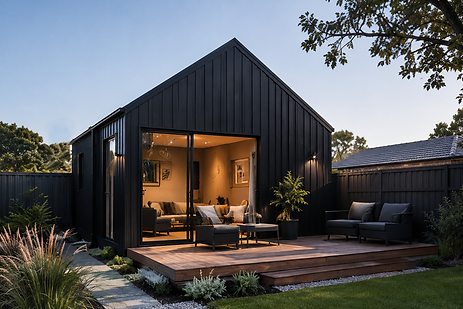
For homeowners, that creates new opportunities for independent family accommodation, rental income, downsizing and making better use of an existing property.
But there's an important distinction: building consent exemption does not mean you can build anything, anywhere, without council involvement.
Your site's planning requirements, natural hazards, access, drainage and other constraints still matter. You also need to obtain a Project Information Memorandum (PIM) before starting construction under the exemption.
Here's what the new rules mean, what you need to check and how to approach a granny flat project without committing to a design that may not work on your property.
1. What are the new granny flat rules in New Zealand?
The granny flat building consent exemption came into effect on 15 January 2026. It allows certain small, standalone dwellings to be constructed without applying for a building consent.
To qualify, a granny flat must meet all the relevant exemption conditions, including being a completely new, standalone dwelling that is single storey and no larger than 70m². It must be designed and constructed in accordance with the New Zealand Building Code, with the required work carried out or supervised by appropriately licensed building professionals.

The exemption also has specific design and construction requirements. Simply choosing a floor plan under 70m² does not automatically make a project eligible.
Homeowners can still choose the standard building consent pathway, and some projects will need to use it.
For the full requirements, see the Ministry of Business, Innovation and Employment's granny flat exemption guidance.
2. Do you still need council approval for a granny flat?
Even when your proposed granny flat qualifies for the building consent exemption, there are steps you must complete before construction begins.
You must apply for and receive a PIM from your local council.
A PIM provides information about your proposed building work and the property, including relevant site conditions and council-held information that may affect your plans.
It is not a building consent, nor does it guarantee that your proposal complies with every applicable requirement.
You also need to establish whether the project complies with the relevant planning rules or requires resource consent. Other approvals or infrastructure requirements may apply depending on the property.
Once construction is complete, the council must be notified and supplied with the required documentation.
Planning a granny flat but unsure where to start?
MAV Studio offers a Granny Flat Preliminary Design + PIM service, helping homeowners establish an initial design direction and prepare for the PIM stage.
3. Can you build a granny flat on any property?
No. The size of the proposed dwelling is only one part of the equation.
Before purchasing plans or committing to a build, it's important to understand what your property can accommodate.
Depending on the site, relevant considerations may include:
Site coverage: How much of your property is already occupied by buildings and how much additional development is permitted.
Boundary setbacks: Whether the proposed dwelling can be positioned the required distance from neighbouring properties.
Natural hazards: Flooding, coastal hazards, unstable ground and other conditions that could affect the project.
Access: Whether there is suitable access for construction, occupants and emergency services.
Infrastructure: Whether existing water, wastewater and stormwater systems can support another dwelling.
Easements and legal restrictions: Whether there are limitations on where you can build.
Planning requirements: Whether the proposal complies with the rules applying to your particular property.
A relatively flat suburban section may present a straightforward opportunity. A steep Wellington property, coastal site or rural lifestyle block may require a different approach.
This is why it's worth establishing what is possible before selecting a design.
Wondering if your property can accommodate a granny flat?
Before committing to a design, use our Granny Flat Site Calculator to explore whether your property could be suitable.
The calculator is an initial guide. For a more detailed assessment of your site's opportunities and constraints, explore our Site Feasibility Report.
4. Why a feasibility assessment can save money before you build
It's tempting to begin by choosing a floor plan, particularly when there are so many pre-designed granny flats available.
But a design that works beautifully on one property may be unsuitable for another.
A feasibility assessment helps identify potential constraints before significant money is committed to design development, consultants or construction.
Depending on the scope, this may involve reviewing available planning information, site characteristics, access, services and the proposed use of the property.
For example, a homeowner might have enough physical space for a 70m² dwelling but discover that its proposed location conflicts with an easement or creates costly drainage requirements.
Another property might accommodate a smaller dwelling more effectively, with better privacy, sunlight and access.
MAV Studio's Site Feasibility Report is designed to help homeowners understand what their property may support, what remains uncertain and which steps should come next.
For homeowners who already know they want to pursue an eligible granny flat, the Preliminary Design + PIM service offers a more focused starting point.
5. Do you need an architect to design a granny flat?
An eligible granny flat must be designed and built, or supervised, by appropriately licensed building professionals. That doesn't necessarily mean every project requires a registered architect, but professional design input can be valuable.

A granny flat is often a long-term addition to an existing property. Its success depends on more than fitting the required rooms into 70m².
Good design considers how the new dwelling relates to the main house, neighbouring properties and the surrounding landscape.
That includes privacy between the two dwellings, natural light and orientation, indoor-outdoor connections, efficient storage and circulation, accessibility, future flexibility and materials suited to the location.
On a compact site, every square metre matters.
An architecturally considered small home can make better use of limited space while responding to the property's individual opportunities and constraints.
6. Should you choose a pre-designed granny flat or a custom design?
Both approaches can work. The right choice depends on your property, intended use, budget and design requirements.
A pre-designed home can provide an efficient starting point, particularly where the site is relatively straightforward and the layout already meets your needs.
MAV Studio's Collection includes compact architectural homes designed for a range of New Zealand properties.

Forma 45 is a 45m², one-bedroom design that can suit independent family accommodation, a compact rental, a bach or a small primary home.
Ahi 40 is a compact 40m² design for homeowners seeking a smaller footprint, whether for independent family accommodation, guest accommodation or a standalone retreat.
Pavilion 70 offers a two-bedroom layout of up to 70m², providing additional flexibility for family accommodation, guests or longer-term living.
These designs provide a starting point rather than a guarantee of exemption eligibility. Site-specific checks, any necessary adaptations and the appropriate approval pathway must be established before proceeding.
Where the property has unusual constraints or the brief calls for something different, a custom architectural design may be more appropriate.
7. What are the hidden costs of building a granny flat?
The advertised price of a granny flat or pre-designed plan is rarely the complete project cost.
Site-specific expenses can significantly affect the overall budget.
Depending on the property, these may include site preparation and earthworks, foundations and ground improvements, water and wastewater connections, stormwater management, electrical connections, access, construction logistics, professional fees, council charges and development contributions where applicable.
A steep section, restricted construction access or complex ground conditions can change the economics of a project considerably.
Before comparing building prices, establish what is included and what additional work your property is likely to require.
MAV Studio's Building Cost Calculator can provide an initial starting point for budget planning. It is not a substitute for a site-specific construction estimate.
8. What happens after you receive your PIM?
Receiving a PIM is an important milestone, but it is not permission to disregard the remaining exemption conditions.

Before construction begins, your project must meet the applicable requirements, and the necessary design documentation and professional arrangements must be in place.
If the project cannot satisfy the exemption conditions, the standard building consent pathway may be required.
During construction, the work must comply with the Building Code and be carried out or supervised by appropriately licensed professionals.
Once the project is complete, the required completion documentation must be supplied to the council.
You can find further information in MBIE's granny flat resources for homeowners.
9. What should you do before buying granny flat plans?
Before purchasing plans or committing to a building contract, establish three things.
First, understand your site. Check the property's planning requirements, physical constraints, infrastructure and any relevant legal restrictions.
Second, establish the appropriate approval pathway. Determine whether the proposal is likely to qualify for the building consent exemption, whether resource consent is required and what other requirements apply.
Third, choose a design that works for the property. Consider orientation, privacy, access, construction costs and how the dwelling will be used over time.
For answers to more specific questions about PIMs, rural properties, boundaries and approvals, read our Granny Flat FAQs.
You may also find our guide to building consent in New Zealand useful when comparing the exemption with a standard consented project.
Planning a granny flat? Start with your site.
The 2026 granny flat rules create new opportunities for New Zealand homeowners, but a successful project still starts with understanding the property.
MAV Studio can help you establish an appropriate starting point, whether you're considering a pre-designed small home, exploring the exemption pathway or investigating the wider development potential of your land.
Explore our services:
Granny Flat Preliminary Design + PIM for homeowners ready to explore a granny flat design and the PIM process.
Site Feasibility Report for a broader assessment of your property's development potential and constraints.
MAV Collection to explore our pre-designed architectural homes.
MAV Custom for properties or briefs requiring a tailored design.
Contact MAV Studio to discuss your property and the next steps for your project.
Comments